Thursday, January 31, 2013

Armacost Library: More Than Just Books!


Image of students studying at Armacost LibraryI’ve worked here in the Library for four years now. In that time, I have discovered there is more to a library than just books.  

Sure, patrons come in to check out books, search our wide array of databases, and get research help.  But they also come in to see our beautiful displays in the lobby that continually change and  show everything from student art, upcoming library events, local history, and other aspects of campus life you might not be aware of.  Our study lounges are inviting and conducive to learning and collaboration.  If you're looking for quiet and a space to de-stress, we have those too.  


Image of Sandi Richey with student at circulation desk
And then there’s our wonderful staff,  always available and always happy to help.  Whether you need a library card, help locating materials, or have questions about anything in the library or on campus, our staff is here to help. 

Debbie Alban
Administrative Assistant
Armacost Library, University of Redlands
x8092

Tuesday, January 29, 2013

Bridging Cultures Bookshelf: Muslim Journeys @ Armacost Library


The University of Redlands Armacost Library is one of 840 libraries and state humanities councils across the country selected to receive the Bridging Cultures Bookshelf: Muslim Journeys from the National Endowment for the Humanities (NEH) and the American Library Association (ALA). The program aims to familiarize public audiences in the United States with the people, places, history, faith and cultures of Muslims in the United States and around the world.

The Bridging Cultures Bookshelf: Muslim Journeys is a project of the National Endowment for the Humanities, conducted in cooperation with the American Library Association. Major support for the Muslim Journeys Bookshelf was provided by a grant from Carnegie Corporation of New York. Additional support for the arts and media components was provided by the Doris Duke Foundation for Islamic Art. Local support is provided by University of Redlands Campus Diversity & Inclusion and Redlands Peace Academy.

For information about these new materials and programming associated with the Muslim Journeys project, please visit Armacost Library's website or contact Melissa Cardenas-Dow, Outreach Librarian, at 909-748-8089 or Melissa_Cardenasdow@redlands.edu.


American Library Association


National Endowment for the Humanities


Friday, January 25, 2013

Expressing Soul Through World Book Night


The deadline for World Book Night book giver applications is 11:59 p.m. on Friday, January 25, 2013. Armacost Library is a pick-up location for World Book Night 2013.

My decision to become a World Book Night book giver was not a difficult one to make. I am a librarian, after all. The hard part came in choosing which book titles to give, at which location to distribute books, and in saying why. Much like selecting a gift, I selected my book title as a means of demonstrating my hopes, dreams, and wishes for the receiver.

But in 2012, this was an easy decision to make. Among WBN’s titles was Sherman Alexie’s The Absolutely True Diary of a Part-Time Indian. The book is one of my favorite texts. At the time I needed to decide which books to select, it had been on my mind because I had just finished organizing University of Redlands’ first Banned Books Week read-out. A reader chose to read out loud from The Absolutely True Diary. If no one had chosen to read from the book, I was prepared to do so.

I originally wanted to give out The Absolutely True Diary at a local senior center in Redlands, California. I thought seniors could benefit greatly from the truths within its pages, despite the book's young-adult intended audience. This is what I wrote in my 2012 WBN book giver application, so I was fairly comfortable with my decision. But after more thought and reflection, I went to Micah House and the Redlands Community Center and gave books to youth and teens I found there. My change of heart stirred after I talked to my oldest daughter about a shooting that occurred in our neighborhood in early 2011. My decision became set after I reread Sherman Alexie’s Wall Street Journal article on young adult literature. I sought the article out after a chance conversation with a friend. In the article, Alexie states, “I write to give them [teenagers] weapons—in the form of words and ideas—that will help them fight their monsters.”  Alexie’s words resonated with something deep and strong inside me. Facilitating that sort of self-empowerment, through words and ideas, is what makes my career as a librarian a vocation.

For WBN 2013, I have chosen to give away Norton Juster’s The Phantom Tollbooth as my first choice. I will be returning to Micah House and, again, focusing my book giving on youth and teens. And, like last year, one of my greatest hopes and wishes is for young people to realize their own power, to find solace, comfort, and strength in words and ideas.


Melissa I. Cardenas-Dow
Outreach/Behavioral Sciences Librarian
Armacost Library, University of Redlands
909.748.8089
Melissa_Cardenasdow@redlands.edu

Wednesday, January 16, 2013

Does your library have eBooks?


Well, does it? My hope is that you responded with a confident YES, however, if you doubted yourself for a second never fear and rest at ease as I will make searching for eBooks as easy as 1, 2, 3. 
Why eBooks?  According to a survey conducted by the Chief Officers of State Library Agencies (COSLA) in the summer of 2011, eBooks will be the preferred format for reading material in the future.  So here is to a New Year’s resolution to reading more-electronically that is (go figure!).  Did I mention its available 24/7?  YES, during those times when the library is closed, our eBook collection is available to you. So if you choose to download a new book late Friday or Saturday evening or early morning (2 a.m.) you can!  
How? Here comes the 1, 2, 3.
1.    Click on Advanced Search on the library’s homepage in the tab “Find Information”


2.    Enter a search term in any field and (here’s the trickiest part of all) in “Add Limits (Optional)” under “Material Type:”– Click EBOOKS.  Don’t forget to hit Submit.


3.    Find a title that interests you, click on the link under “Online Content” and Happy Reading! It's that simple!


Want to browse by category?
Check out our database EBSCO Ebook Collection to easily browse by category.  Simply click
on the “eBooks” tab on the top left corner to get the list of categories.   


World Book Night USA 2013 extends giver deadline to January 25!


Armacost Library is again signed up to be a pick-up location for World Book Night USA (WBN-USA). This means givers can choose Armacost Library as a location to receive their free WBN books to give away.

What do you need to do to be a book giver through WBN? Select 3 books you have personally read, choose the location where you intend to distribute books, and submit an application through WBN’s official site by Friday, January 25, 2013.

This year, groups of 10 or more individuals are encouraged to send a single application by emailing a proposal at April23@WorldBookNight.org. Please include the following information in your group proposal:

1.       Top three book choices OR why you would like a selection of several titles.
2.       Where do you intend to give away the books?
3.       To whom do you intend to giveaway books to?
4.       Why do you want to give books away?
5.       Why do you want to give the books out as a group? How many givers are in your group?

Through WBN, book givers pledge to distribute books on April 23, 2013. For additional information about World Book Night, please contact Melissa Cardenas-Dow, Outreach Librarian, at Melissa_Cardenasdow@redlands.edu or 909-748-8089.

Wednesday, January 09, 2013

Our Story: 2011-2012 Armacost Library Annual Report

Welcome 2013.  With every new chapter, it's good to remember the proud accomplishments and successes we endeavored in the past year.  The year that ran from July 1, 2011, to June 30, 2012, was another extraordinary year for the Armacost Library.  As we prepare ourselves for another exciting year ahead of us, let us take this time to relive the past by taking a look at our inaugural annual report.  Our annual report has been put together to tell our story about the great and remarkable resources, services and collections the library offers the students, faculty, staff and community of the University of Redlands. 

We hope you enjoy the report and continue to support the library and its mission and vision to play an integral role in the intellectual and cultural life of the University of Redlands by facilitating the transformation of information into knowledge.

We invite you to visit us physically or virtually to learn more about our dynamic work as we respond to the information needs of the present and prepare for the future.

Learn more about Armacost Library @ http://library.redlands.edu/aboutus

Happy New Year!

Thursday, January 03, 2013

A Really Easy New Year’s Resolution


Happy New Year and welcome back to school. Have you made a list of resolutions for the new year? Things that could improve your life, make you healthier, get you to a better place in life?

I’d like to make a recommendation for you. It’s easy, lots of fun and will definitely improve your life, your grades and your ability to succeed in college.

Is all that possible? ABSOLUTELY – Add this to your list:

I WILL GET TO KNOW MY LIBRARIAN!

What? Yes! Start by going to the library homepage to see who that person may be. Click here for more information: http://library.redlands.edu/mylibrarian

Then:
  • Stop by during their office hours, just to say hi.
  • Make an appointment when you get those assignments that look overwhelming.
  • Send a chat message when you have a quick question or send an email and get your answers in no time!


What could be better? That librarian will work with you through all your time here to make sure you are getting the right information for your research papers and projects. They will be there when you organize that thesis proposal or gather your wits around the senior capstone project. And they will be there to applaud your success when you walk across the stage to receive your diploma.

Just do it! Get to know your librarian this New Year and make your life much easier and much better.  

– Gabriela Sonntag, Armacost Library Director (909-748-8096)

Friday, December 14, 2012

Librarians Need Sandboxes Too

As the Web Experience Librarian, I'd been itching to edit our interlibrary loan pages. Just this week I found time to get started on the interface that everyone uses to submit their interlibrary loan requests. Since this is the first time I've tinkered with the back end of ILLiad, our interlibrary loan program, I was curious to hear of an ILLiad "test web." It got me wondering and hoping that it was a kind of web sandbox, that is, a space where I could test changes to the website before these changes went live. It is! With the ILLiad manual giving only a brief mention of this and with my many unanswered questions, I jumped in and figured out how to make it work. So if you're a web librarian yourself and are interested in learning more, here's how I did it.

Create a Test Web in ILLiad


Create a sandbox where you can experiment with and test customizations to your ILLiad web interface.
  1. Identify your base URL for all of your ILLiad pages. (E.g. The base URL for http://redlands.illiad.oclc.org/illiad/logon.html and http://redlands.illiad.oclc.org/illiad/ArticleRequest.html is http://redlands.illiad.oclc.org/illiad/. What this base URL basically says is that on the Redlands ILLiad server, the web pages reside within a folder called “illiad.”
  2. Find this folder on your ILLiad server. Within the folder called “illiad,” create a subfolder called “testweb.”
  3. Within the folder called “testweb,” create a .txt file called webpath.txt. You may use Notepad or some other program to create a .txt file. If you already have a webpath.txt file, move it here.
  4. I’m not sure why this works, but within the webpath.txt file, you need to give computers directions to this file. Your directions will basically say, “Computer, this file is located inside the ‘testweb’ folder which is inside the ‘illiad’ folder which is inside my base URL. For example, webpath.txt could look like this:

    redlands.illiad.oclc.org/illiad/testweb/

  5. Now that computers know where to look, you need to give it things to look at. Copy and paste your web pages, CSS files, etc. to your “testweb” folder.
  6. Test that you’ve done everything right by looking for these files in your browser. For example, visit http://redlands.illiad.oclc.org/illiad/testweb/ArticleRequest.html. Test Web pages should closely mimic live ILLiad web pages, but may not be appear identical.

Thursday, November 29, 2012

What's Happening in the Mathematical Sciences

What's Happening in the Mathematical Sciences
Whether you're an undergraduate math major looking for a research topic or just a general fan of math, I think you'll find the series What's Happening in the Mathematical Sciences rather delightful.

Delightful?!

Yes, delightful. Not only does every chapter (in this currently eight volume set) report some recent mathematical advancement, but it does so with the skill of a good storyteller. Math isn't just about numbers, calculations, theorems, and proofs. It's about the opportunities seized and adventures taken by explorers who push the boundaries of what we know, or assume to know. For example,
  • Can undergraduates actually impact the field of mathematics? (See vols. 1 and 2)
  • What's it like to solve Fermat's Theorem, only the most famous math problem? (See vol. 3)
  • When is art, math? (See vol. 4)
  • Want to reduce traffic? (See vol. 5)
  • How do dragonflies hover? (See vol. 6)
  • What is the millionth digit of pi... without calculating to the millionth digit? (See vol. 6)
  • Ever flipped a coin to make a decision? Maybe that's not such a good idea. (See vol. 7)
  • Can mathematics replace clinical trials in health care? (See vol. 8)

Check it out!

Paige Mann
Physical Sciences Librarian

2-D Design Art


The two-dimensional design class develops their skills in designing through exploration of the elements and principles of design.  Students' understanding of composition, shape, value, texture, space and color are explored through various assignments.

The work on display in the Armacost Library are examples of these explorations.  Please visit the exhibits on the 2nd floor of the library until December 7th.


ART 132  2-D Design
Instructor - Renee Azenaro
Studio Art

Monday, November 26, 2012

U.S. World Book Night 2013!

World Book Night 2013 has announced their book selection list and opened sign-ups for book givers. Visit the links to participate! Armacost Library will be a pick-up location for WBN 2013. This will be the second time Armacost Library will be participating as a pick-up location for book-givers. 2013 is also the second time WBN is being held in the United States.

Want to know more about World Book Night? Visit WBN's FAQ page. WBN 2013 is scheduled for April 23, 2013.

UPDATE: World Book Night 2013's book giver deadline has been extended to Friday, January 25! Be sure to submit your application to WBN.

Monday, November 19, 2012

Looking for Public Affairs information?

PAIS Public Affairs Information Service
WOW! What a great resource for Public Affairs research!

PAIS (Public Affairs Information Service) provides access to information from 1977-present with a practical rather than a theoretical focus chronicling the world's public affairs, public and social policies, international relations, and world politics with over half a million journal articles, books, government documents, statistical directories, grey literature, research reports, conference papers, web content, and more. Find PAIS on the article databases page.

Major policy areas covered include:
  • administration of justice; law and ethics
  • agriculture, forestry, fishing and agricultural policy
  • banking, public and private finance
  • business and service sector
  • culture and religion
  • education
  • energy resources
  • environment
  • government and politics
  • health conditions
  • human rights
  • labor conditions
  • manufacturing and heavy industry
  • media, telecommunications and information
  • military and defense
  • population groups, population and demographics
  • science and technology
  • social conditions
  • transportation ...

Search screen shot

Details on PAIS provided by Gabriela Sonntag, your Government Librarian (909) 748-8096.

Friday, November 16, 2012

Learning Spatially at the University of Redlands (LENS)

Creating one's own map story is an activity that anyone can do. To do it well, however, takes some knowledge and skill. At the University of Redlands, geographic understanding and spatial literacy is a significant part of the education we provide.

LEarNing Spatially at the University of Redlands
The LENS (LEarNing Spatially) initiative at the University of Redlands helps establish geography and spatial literacy as an important foundation of liberal arts higher education. Through workshops, courses, and consultations with faculty and staff, LENS develops capacity of our University communities to think spatially. According to LENS, spatial thinking is the "ability to visualize and interpret location, distance, direction, relationships, movement, and change through space." The work LENS does is enhanced by the teaching and research conducted at the University of Redlands MS GIS program and Redlands Institute. The U of R Master of Science in Geographic Information Systems program is a one-year intensive program geared to professionals who are interested in developing and enhancing their knowledge and skills in geographic information, science, and technology. The Redlands Institute conducts interdisciplinary research applying GIS to issues and problems on local, regional, and global scales.

The Redlands Institute
University of Redlands MS GIS Program


Social Explorer Professional Edition

Armacost Library supports the University of Redlands campus-wide spatial learning initiative spearheaded by LENS. Not only do we have print maps and U.S. census data available, we provide access to Social Explorer Professional Edition to currently enrolled students and currently affiliated faculty, staff, and administrators of U of R. Social Explorer is an online digital mapping resource that allows users to create maps and reports using current and historical U.S. census data. Social Explorer also has a Free Edition that allows users to make maps and reports from a smaller subset of demographic information. See Social Explorer's how-to videos to get started right away.

LENS is generously supported by Esri and the W.M. Keck Foundation.

Thursday, November 15, 2012

Telling Stories With Maps

Previously we talked about the storytelling power of print maps. The map displays at Armacost Library and A.K. Smiley Public Library highlight some ways print maps can be an important part of storytelling. Using web-based digital maps to bring a tale to life is yet another powerful way to infuse geography into a narrative. The use of both print and web-based maps are just some of the tools available to students, faculty, staff, and administrators at University of Redlands. Maps, whether printed or web-based, are basic spatial information that are important elements of map-based storytelling.

Telling stories with maps is a great way to "better understand the interconnectedness that makes the world work" and help story-map creators, users, and viewers "become better world citizens" (Esri, Telling Stories With Maps: A White Paper, February 2012).

Story maps can have various purposes. Still, all share general elements and principles that include a simple, clear message, spatial information, and user experience. Below is an example of a story map that gives us a picture of the 2008 presidential election. The story map invites users to consider the past as a means to think about the future. It also melds data based on location with information based on individual and group behavior and categories. The story map also invites us to interact, learn, and explore. Even ask questions.

image of the interactive online map of the 2008 presidential election results by precinct
Past As Prologue? 2008 Presidential Election Results By Precinct
A story map powered by Esri


Wednesday, November 14, 2012

November 14 is GIS Day 2012


Geography and spatial skills help us see the world in different ways. GIS (geographic information systems) allow us to make connections and see novel, even unexpected, patterns from well-known, commonplace information. Esri's Matt Artz blogs, "With GIS we are not simply replacing paper-and-ink-based maps with maps on computer screens, but we are evolving and extending the definition of what 'maps' are and how we use and interact with them."

On GIS Day, November 14, 2012, presenters from different organizations within and around Redlands, California will talk about GIS and its uses in different contexts. All presentations will be held in A.K. Smiley Public Library's Assembly Room, starting at 3 p.m. From 5 to 5:30 p.m., David Smith, University of Redlands' GIS and Mapping Consultant, will speak about the uses of GIS technology on campus for classroom teaching, research, and practical projects. Students from the University of Redlands MS GIS program will also be available to provide information.

Tuesday, November 13, 2012

Maps Tell Stories

When we think of maps, we are often confronted with many questions. One of the most common is: "What is the map of?" Such a simple question. Or so it seems.

In our quest to understand what we are looking at, we are taken by the simplicity of maps. We overlook that maps, as Esri's Matt Artz stated, "are abstractions of geography." They focus information and communicate complex matters succinctly and easily. Within the finite border of a paper map, elaborate concepts can disappear to allow us to make use of the information it provides.

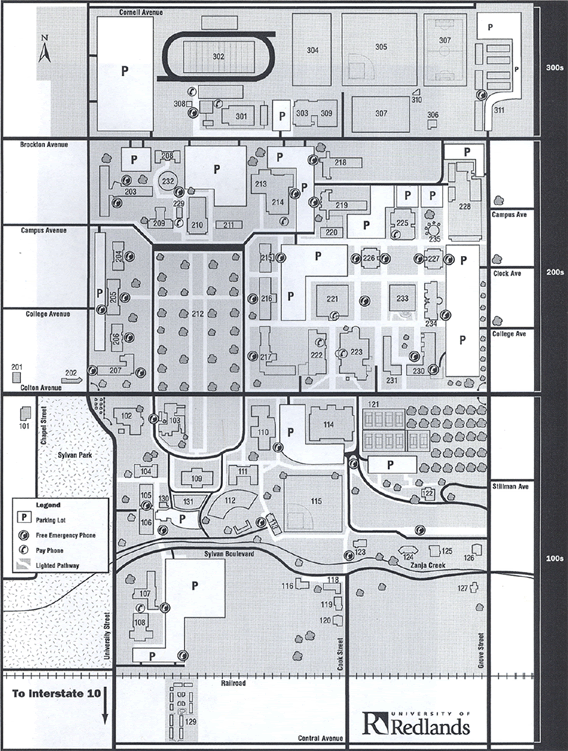
Sometimes the stories maps tell are obvious. A map of the University of Redlands campus, for example, tells a viewer what the most valuable pieces of information are. Because of this, we can logically assume that the campus map is geared towards people who need to know where to park their vehicle and are concerned about safety while on campus.

Other times, the stories maps tell may not be readily evident. A bird's eye view map of the City of Redlands from 1888, courtesy of the Redlands Area Historical Society, for instance, may provide stories that may not resonate with viewers from 2012.

Until a map is placed in context with other information-bearing objects, such as books, other maps, pictures, films, poems, or letters, the ability of maps to tell stories can go unnoticed.

Armacost Library's Geography Awareness Week displays highlight the ability of maps to tell stories. To help library visitors and patrons understand the storytelling power of print maps, we created a brochure that stresses the links between written works and the geographic information they contain. By pairing maps with books and images, we are calling attention to the importance of place and location in history, fiction, cultures, and art.

The Geography Awareness Week brochures, along with the University of Redlands Armacost Library and the A.K. Smiley Public Library map displays, are part of the GIS Day community events in Redlands, California.

Inside panel of Armacost Library's Geography Awareness Week brochure

Monday, November 12, 2012

Maps on Display at Armacost Library

As a companion to the A.K. Smiley Public Library display, a sister exhibit at Armacost Library was created by Armacost Library GIS and maps intern Stephanie Milner and outreach librarian Melissa Cardenas-Dow. Like the display at A.K. Smiley, the Armacost Library layout featured images of maps and books. This time, they are all from Armacost Library's collections.

Armacost Library's display also focuses on local, historic California. The exhibit's focal map is one that depicts the Salton Sea. It is paired with a copy of Marine Geology of the Gulf of California, edited by Tjeerd Van Andel  (1964). Photos of a map of Redlands from 1957 is paired with Redlands, Our Town by Frank E. Moore, with sketches by Jeff Owens (1984). A map of the city of Riverside is matched with a working paper from 1991, The National Orange Company Packing House: An Architectural and Technological History, 1898-1940 by Ronald Tobey, Charles Wetherell, Kevin Hallaran, and Buffie Hollis, published the University of California Riverside Department of History. Images of a map of Carmel-by-the-Sea accompanies the text Cruising With Robert Louis Stevenson: Travel, Narrative, and the Colonial Body by Oliver S. Buckton (2007). Pictures of a map of the territories of Gabrielino tribes correspond with O, My Ancestor: Recognition and Renewal for the Gabrielino-Tongva People of the Los Angeles Area by Claudia Jurmain and William McCawley (2009) and Tovangar (World): A Gabrielino Word Book by Anne Galloway (1978). The San Bernardinos: The Mountain Country From Cajon Pass to Oak Glen, Two Centuries of Changing Use by John W. Robinson (1989) is paired with a map showing routes from the Orange Belt cities in Southern California to the San Bernardino mountain resorts.

Geography Awareness Week 2012 display sign at
Armacost Library, University of Redlands
and A.K. Smiley Public Library

Geography Awareness Week 2012 display
at Armacost Library, University of Redlands


Highlighting the historical, artistic, and narrative significance of maps and map-making are the signs Stephanie Milner created to draw library visitors to the 2012 Geography Awareness Week displays. The display sign has two bird's eye view images of historic Los Angeles, California. The top image is a view of the city from 1877. The bottom image is from 1909. Both images came from the Library of Congress digital collections.

University of Redlands Armacost Library's Irvine Map Collection is currently being reorganized. Maps from the collection are still available for viewing and study upon request.

The University of Redlands Armacost Library map display, and its sister exhibit at A.K. Smiley Public Library, are part of the GIS Day community events in Redlands, California.

Sunday, November 11, 2012

Armacost Library Display at A.K. Smiley Public Library

In preparation for Geography Awareness Week, Armacost Library's GIS and maps intern Stephanie Milner and outreach librarian Melissa Cardenas-Dow erected a small display of maps and images highlighting the storytelling power of maps. The display features images of maps from Armacost Library that are significant to books available at A.K. Smiley Public Library.


picture of display of images of associated maps and books at A.K. Smiley commemorating Geography Awareness Week 2012
Geography Awareness Week 2012 display
at A.K. Smiley Public Library
The entire display consists of images of maps and books that show the historical past of California. In the middle of the display is a bridle trail map of Redlands from 1941. This map, from A.K. Smiley's Heritage Room collection, depicts different trails in and around the city of Redlands. Many of the trails have been used for centuries. Some are now part of private property and are closed to the public. Others are part of the Redlands Conservancy's Heritage Trails Project, which preserves and maintains historic rural spaces in Redlands for city residents and visitors to enjoy.

Surrounding the bridle trail map from A.K. Smiley's Heritage Room are images of maps from University of Redlands, Armacost Library's Irvine Map Collection. All are paired with books from A.K. Smiley's circulating collection.

A City of Redlands map from 1957 brings geographical context to Redlands Remembered: Stories From the Jewel of the Inland Empire by Joan Hedges McCall (2012). A map of the territories of Gabrielino and adjoining Native American tribes complements The First Angelinos: The Gabrielino Indians of Los Angeles by William McCauley (1996). A map of Carmel-by-the-Sea, a small city in the Monterey Peninsula of central California, is paired with Robert Louis Stevenson's 1883 novel Treasure Island. The real-life California coastal location has long been lauded as the inspiration for Stevenson's book. The Elephant Quilt: Stitch by Stitch to California! by Susan Lowell and Stacey Dressen-McQueen (2008), a tale chronicling young Lily Rose's journey from Missouri to California, is supported by images of an 1861 map of Missouri and a 1954 map of California.

University of Redlands Armacost Library's Irvine Map Collection is currently being reorganized. Upon request, maps in the collection are still available for viewing and study.

The A.K. Smiley Public Library map display, and its sister display located at University of Redlands Armacost Library, are part of the GIS Day community events in Redlands, California.

Thursday, November 08, 2012

Geography Awareness Week 2012

Several University of Redlands departments, including Armacost Library, will be celebrating Geography Awareness Week 2012 from November 11 to 17.

Armacost Library will have a display highlighting how cartographic materials tell stories. A sister display at A. K. Smiley Public Library will also be created to mark the occasion. The displays will be available for viewing starting November 12th. The Armacost Library display will be located on the 2nd floor, near the Popular Books shelves. The display at A. K. Smiley will be located in the hallway leading to the Heritage Room.

A number of presentations will be marking Wednesday, November 14th, GIS Day, at A. K. Smiley's Assembly Room. David Smith, U of R's Mapping and GIS Consultant, will give a presentation on the use of GIS technology on campus. His presentation is slated from 4:30 p.m. to 5:00 p.m. Students from MS GIS will also be on site to answer questions about the program.

Wednesday, November 07, 2012

Backstage Handbook: an Illustrated Almanac of Technical Information


This is truly a one-of-a-kind resource for theater majors and others involved in theatrical production. Written by a stagehand who was frustrated that he had to consult numerous sources to get basic technical information, the Backstage Handbook is an excellent resource to consult while designing. Topics include:

  • Specialized tools and equipment needed for set construction
  • Fasteners (nails, bolts, hooks, etc.) and properties of materials (wood, plastic, chemicals, etc.) used in construction
  • Electrical and lighting systems
  • Quick reference formulas and shop math (algebra, geometry and trigonometry)
  • Basic set design principles (what's the difference between a proscenium and a thrust stage?)
Save time searching the web for this information and stop by the Reference Collection to get it all in one place! You'll find the Backstage Handbook, and a lot more useful theater reference books, here.

Sanjeet Mann
Arts Librarian